
Breast Implants: Above or Below the Muscle?
Posted January 22, 2026 in Breast Implants
For many years, plastic surgeons almost always recommended placing breast implants behind the chest muscle. That approach became the standard, and at the time, it made a lot of sense. But as implant technology has improved, the rules have changed. Many patients are unaware that there are different options for breast implant placement, and the procedure is highly personalized to each individual’s needs.
Today, we are seeing a major shift toward placing implants above the muscle in the right patients, with excellent safety and aesthetic results. Many factors, such as anatomy, lifestyle, and desired outcome, influence where implants are placed.
6 Min Read:
Why Were Implants Traditionally Placed Behind the Muscle?
There were two main reasons surgeons favored placing implants behind the pectoralis major muscle.
- Capsular Contracture: Capsular contracture is a long-term complication of breast augmentation where the scar tissue that naturally forms around the implant becomes thick and tight. When this happens, the breast can feel firm, look distorted, and often requires additional surgery. Older studies showed that smooth implants placed above the muscle had a much higher risk of capsular contracture. Placing the implant behind the pectoralis major muscle significantly reduced that risk, so it became the standard recommendation.
- Rippling: Older implants were essentially a shell filled with gel. In patients with thin tissue or very little natural breast volume, implants placed above the muscle were more likely to show visible rippling. The pectoralis major muscle acted as an extra layer of coverage, helping smooth out the appearance.
Over-the-muscle placement, also known as subglandular placement, refers to placing implants on top of the pectoralis major muscle and under the glandular breast tissue (glands). In this technique, the implant sits between the chest muscle and the existing breast tissue, with the glands and any existing breast tissue providing coverage and influencing the final appearance.
At the time, placing implants behind the muscle was the safest and most predictable option.
Why This Thinking Has Changed
Modern implant technology has changed both of those concerns.
Today’s implants have much lower capsular contracture rates overall. Even more important, large studies now show that there is no meaningful difference in capsular contracture rates whether the implant is placed above or below the muscle. In other words, placing modern implants above the muscle does not increase risk.
Implant rippling is also far less common with newer implants. These implants are not just “gel in a bag.” They have a more uniform structure, are more completely filled, and maintain their shape much better. This dramatically reduces rippling, even when placed above the muscle. Both silicone implants and saline implants have seen significant improvements in recent years. Silicone implants are known for better shape retention and a more natural feel, while saline implants have also improved in appearance and feel.
The size of the breast implants can affect the visibility of rippling through breast tissue, and there is a slightly greater risk of rippling with subglandular placement, especially in patients with little natural breast tissue.
Once those two historic problems are addressed, surgeons can choose implant placement based on anatomy, comfort, long-term appearance, and implant type (silicone or saline) rather than outdated limitations.
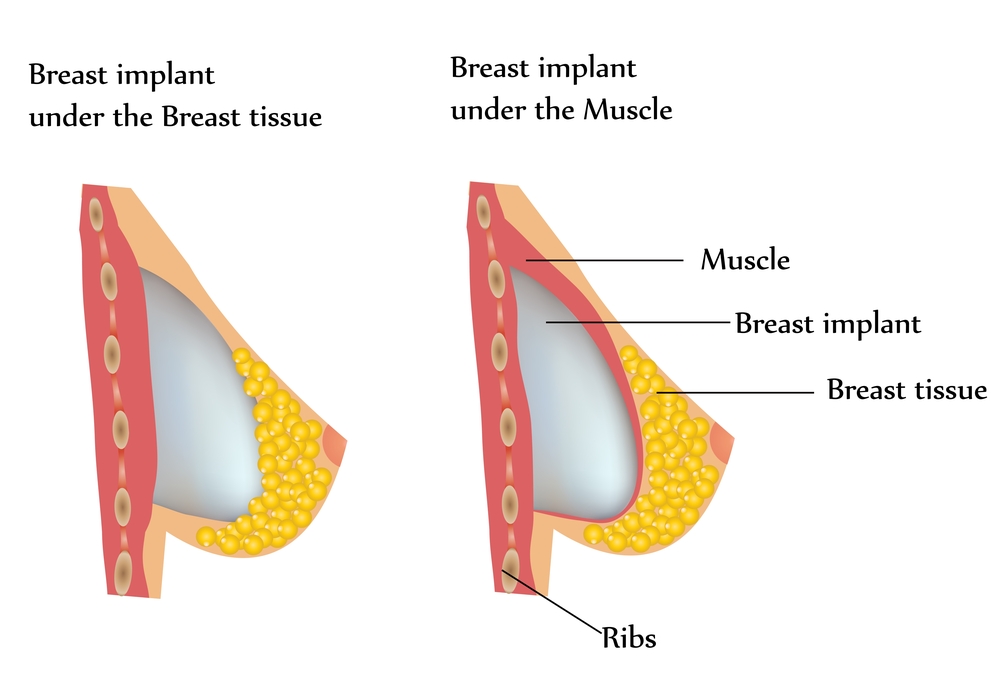
Understanding Implant Placement: Above vs. Below the Muscle
In the image above, you can see the two main implant positions clearly:
- Behind the muscle (submuscular placement): The implant sits partially under the pectoralis major chest muscle. To make room, the lower portion of the muscle must be released from the chest wall, and the implant is covered by both muscle and natural tissue.
- Above the muscle (subglandular placement): The implant is placed above the pectoralis major chest muscle and under the skin and natural breast tissue, leaving the muscle completely intact.
Submuscular placement provides a smoother transition between the implant and the chest wall, which can help achieve a more natural appearance, especially in women with less natural tissue or skin coverage.
This visual highlights an important difference. When surgeons place implants behind the muscle, it requires altering normal anatomy, while placing them above the muscle preserves it.
How much breast tissue you have is a key factor in determining the best placement option. The amount of natural breast tissue and skin coverage influences where to place implants. Women with little natural tissue or thin skin may benefit from submuscular placement, while those with more breast tissue are better candidates for subglandular placement, as their natural tissue can better hide their implants. Larger breasts or choosing larger implants may increase the risk of visible rippling, but adequate natural tissue and skin coverage help keep the implant covered and achieve a look closer to natural breasts.
Advantages of Placing Implants Above the Muscle
When implants are placed above the muscle in properly selected patients, several advantages become clear.
- Better cleavage: When implants are behind the muscle, natural muscle attachments along the breastbone can push them outward. Without that muscle pressure, cleavage often looks more natural and centered.
- Less risk of implants shifting outward over time: Muscle movement can gradually push implants toward the armpits. Removing the muscle from the equation improves long-term implant position.
- More predictable shape and projection: Muscle pressure can flatten an implant placed underneath it. Above the muscle, the implant can fully express the shape and projection chosen during surgery.
- Less pain and faster recovery: Because the chest muscle is not cut, stretched, or released, patients typically experience less pain, quicker recovery, and fewer activity restrictions after surgery.
A Muscle-Preserving Approach to Breast Augmentation
This is why many surgeons now describe modern above-the-muscle breast augmentation as a muscle-preserving or preservation-based approach, specifically preserving the pectoralis major muscle. Instead of disrupting normal anatomy to compensate for older implant limitations, we preserve muscle function while using better implant technology to achieve natural, safe, long-lasting results.
This does not mean every patient should have implants placed above the muscle. Factors like tissue thickness, lifestyle, and aesthetic goals still matter. It is vital that patients follow post-operative care advice from professionals to ensure a smooth recovery. Discomfort or pain is quite normal after the procedure and can be effectively managed with painkillers. But the idea that implants must always go behind the muscle is no longer true.
As surgery evolves, so should our approach. Sometimes progress means realizing that what once worked well is no longer the best option for everyone.
Ready to Learn More About Breast Implant Placement in Miami?
Choosing whether breast implants should be placed above or below the muscle is a highly individualized decision that depends on your anatomy, lifestyle, and aesthetic goals. The team at Careaga Plastic Surgery has extensive experience with modern, muscle-preserving breast augmentation techniques and will help you determine the safest, most natural option for you.To schedule a personalized consultation and learn more about your breast augmentation options in Miami, call our office at (305) 574-9262 or complete our online contact form today.